
Employment law changes in 2026 are creating new compliance challenges for employers across the United States. From pay transparency laws and paid leave mandates to AI hiring regulations and employee classification rules, businesses operating in multiple states must stay informed to avoid penalties, lawsuits, and operational disruptions.

While federal employment regulations establish a baseline, state employment laws continue to evolve rapidly. For CEOs, entrepreneurs, HR leaders, and business owners, understanding state-by-state employment law changes has become essential for managing risk and maintaining compliance.
According to the U.S. Department of Labor, employers are responsible for complying with both federal and state labor regulations, many of which vary significantly by location. Businesses that rely on outdated policies or assume a single set of rules applies nationwide often expose themselves to unnecessary legal and financial risks.
That’s why many organizations turn to outsourced HR support, such as PEO services or ASO/HRO solutions, to help monitor compliance requirements, update policies, and implement best practices.
What Are the Biggest Employment Law Changes Employers Should Watch in 2026?
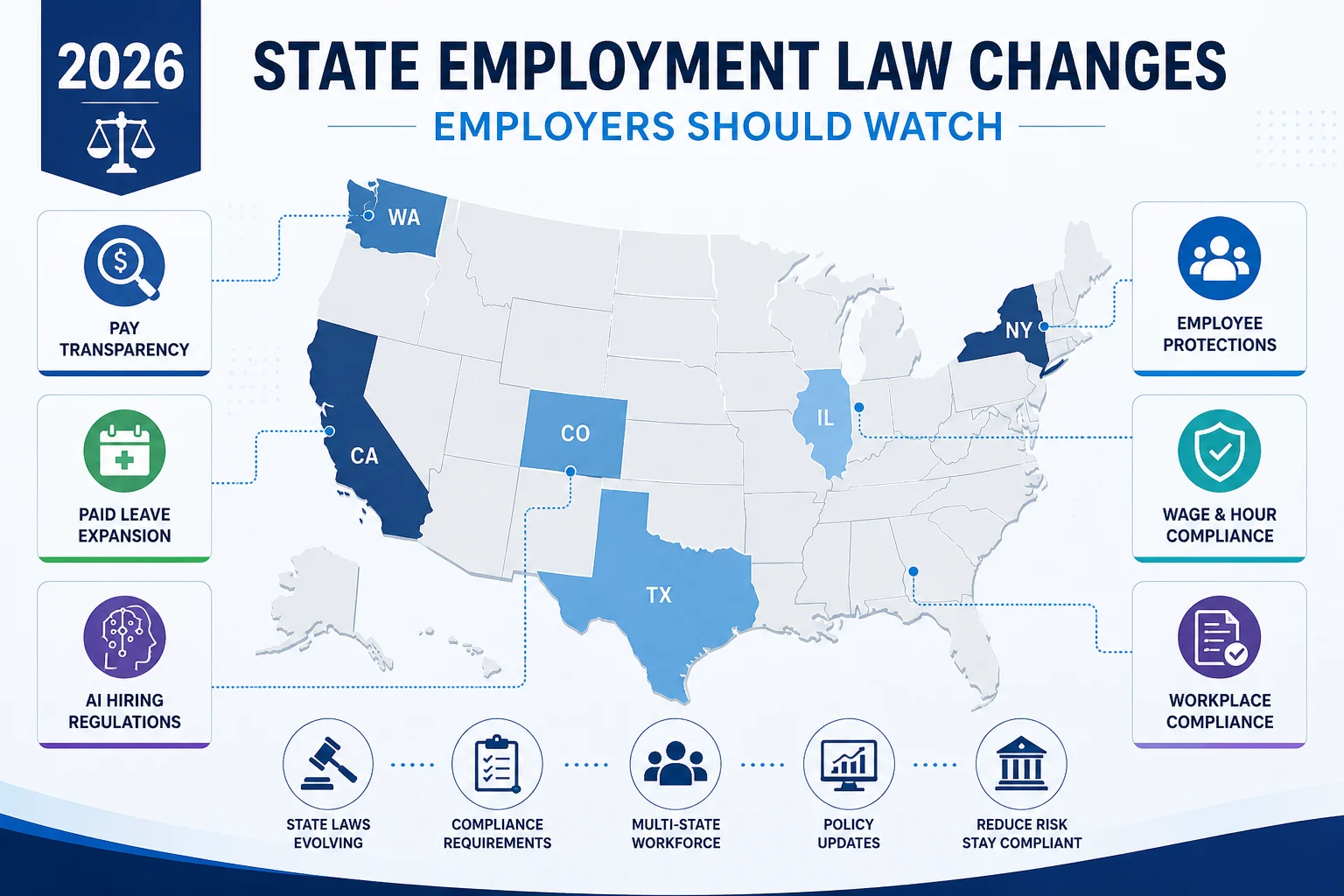
The most significant employment law changes affecting employers in 2026 include:
- Expanded pay transparency requirements
- New paid leave mandates
- AI hiring and recruitment regulations
- Employee classification enforcement
- Wage and hour compliance updates
- Workplace discrimination protections
- Multi-state compliance obligations for remote workers
Employers with workers in multiple states face the greatest compliance challenges because regulations often differ significantly across jurisdictions.
Why State Employment Law Changes Matter More Than Ever
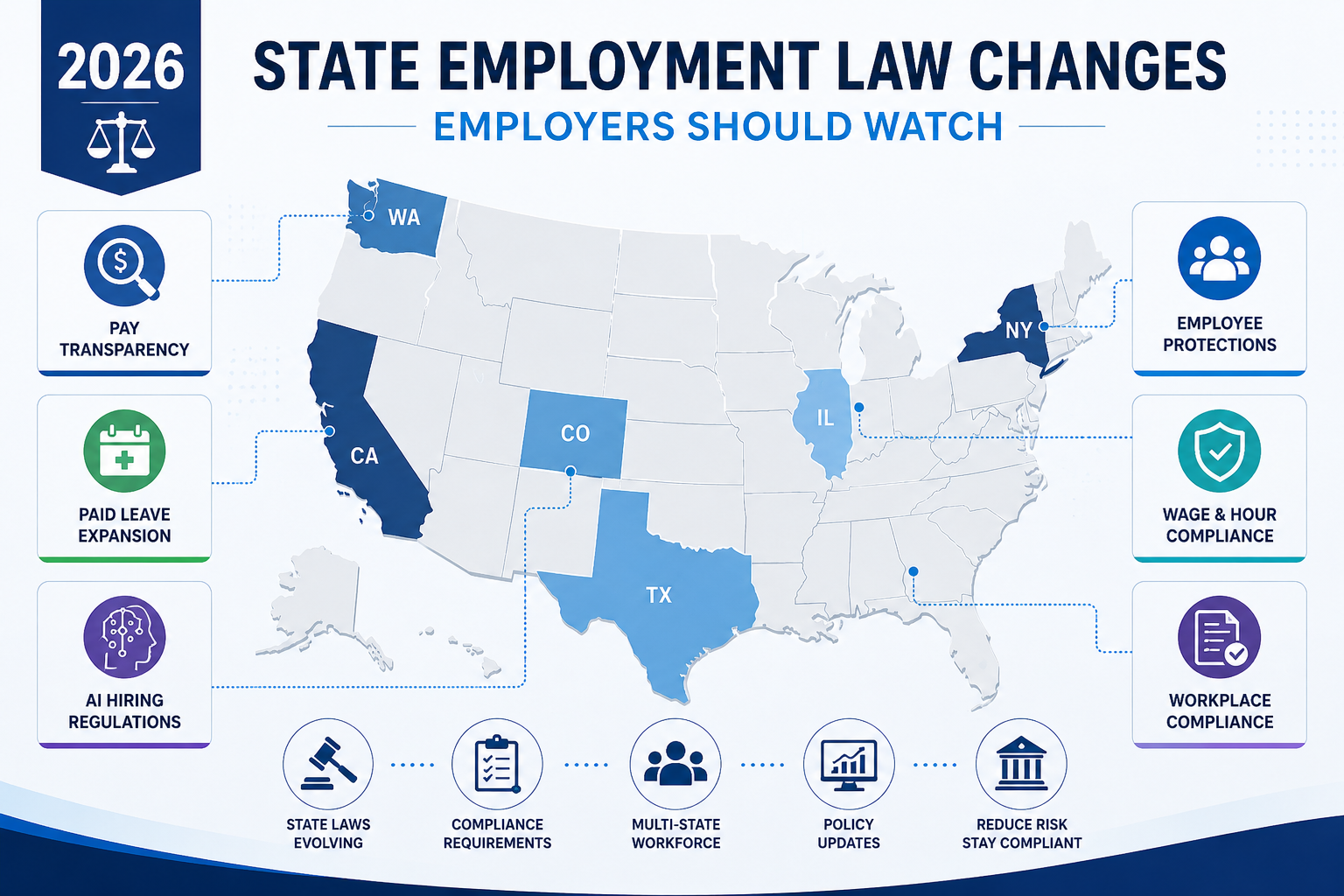
One of the biggest trends impacting employers today is the rapid expansion of state-specific labor laws. States such as California, New York, Illinois, Washington, and Colorado continue to introduce new regulations affecting hiring practices, compensation disclosures, employee leave benefits, workplace protections, and HR reporting requirements.
The rise of remote work has added another layer of complexity. A company headquartered in Florida may employ workers in California, New York, Texas, and Colorado, each with unique requirements governing payroll, leave administration, hiring disclosures, and employee notices.
Without a structured compliance strategy, maintaining consistency across locations can become increasingly difficult.
Businesses evaluating whether a PEO or ASO model is right for them often discover that compliance management is one of the most valuable benefits these solutions provide.
Key Employment Law Changes by State
California
California remains one of the most heavily regulated employment environments in the country. Employers should pay close attention to:
- Expanded pay transparency requirements
- Paid sick leave obligations
- Worker classification enforcement
- Wage and hour compliance regulations
- Workplace discrimination protections
New York
New York continues to strengthen employee protections through:
- Salary range disclosure requirements
- Workplace harassment prevention initiatives
- Paid leave expansion
- Employee rights notices and reporting obligations
Illinois
Illinois has become a leader in regulating workplace technology and hiring practices, including:
- AI hiring and employment decision regulations
- Expanded employee privacy protections
- Pay transparency initiatives
- Workforce reporting requirements
Colorado
Colorado employers should remain focused on:
- Job posting transparency requirements
- Equal pay compliance
- Compensation disclosure obligations
- Workplace fairness regulations
Washington
Washington continues to expand employee protections through:
- Paid family and medical leave programs
- Salary disclosure requirements
- Employee benefit administration obligations
- Workplace accommodation protections
As more states adopt similar legislation, employers should expect compliance obligations to continue evolving.
Pay Transparency Laws Continue to Expand
Pay transparency remains one of the most significant employment law developments affecting employers nationwide.
Several states now require employers to include salary ranges in job advertisements and provide compensation information to applicants and employees under specific circumstances. These laws are intended to promote pay equity, reduce compensation disparities, and increase transparency during the hiring process.
For employers, compliance involves more than simply posting salary ranges. Organizations should:
- Review compensation structures
- Ensure consistency across similar positions
- Train hiring managers
- Document compensation decisions
- Update recruiting and onboarding processes
Organizations with multi-state workforces may need different recruiting practices depending on employee location.
The Equal Employment Opportunity Commission (EEOC) continues to emphasize fair pay practices and equal employment opportunities as key compliance priorities.

Paid Leave Requirements Are Becoming More Complex
State-sponsored paid leave programs continue to expand across the country.
Many states now require some form of:
- Paid sick leave
- Family leave
- Medical leave
- Caregiver leave
- Paid family and medical leave contributions
While these programs provide important protections for employees, they also create additional administrative responsibilities for employers.
Each state’s requirements may differ regarding:
- Employee eligibility
- Benefit accrual methods
- Employer contributions
- Reporting obligations
- Employee notification requirements
For growing organizations, managing these requirements internally can become increasingly challenging, particularly when employees work across multiple jurisdictions.
Many employers leverage PEO services to streamline leave administration, payroll processing, and compliance management.

AI Hiring Regulations Are Emerging
Artificial intelligence is transforming recruitment and talent acquisition, but it is also creating new compliance obligations.
Several states and municipalities have introduced regulations governing the use of:
- AI-powered hiring tools
- Resume screening software
- Automated candidate assessments
- Workforce analytics platforms
Employers should understand that adopting AI does not eliminate compliance responsibilities.
Depending on the jurisdiction, employers may be required to:
- Conduct bias audits
- Disclose AI usage to applicants
- Maintain hiring documentation
- Demonstrate fairness and non-discrimination in employment decisions
As AI adoption accelerates, executive leaders should ensure HR policies evolve alongside technology investments.
Multi-State Compliance Requires a Proactive Strategy
The most successful organizations no longer treat compliance as a reactive process.
Instead, they build proactive systems designed to:
- Monitor regulatory changes
- Update policies regularly
- Train managers
- Conduct compliance reviews
- Reduce legal and operational risks
Businesses expanding into new states often discover that employment law compliance becomes increasingly complex as their workforce grows.
Partnering with HR experts can provide access to:
- Specialized compliance knowledge
- Payroll administration support
- Employee relations guidance
- Risk management resources
- Regulatory monitoring tools
Organizations looking for a scalable compliance strategy often combine outsourced HR support with dedicated payroll and workforce management solutions. For businesses evaluating growth strategies, our guide on multi-state employment compliance explains how HR solutions can help companies scale while remaining compliant.
Frequently Asked Questions
What are the most important state employment law changes employers should monitor?
Employers should closely monitor pay transparency laws, paid leave requirements, wage and hour regulations, employee classification rules, AI hiring regulations, workplace discrimination protections, and remote workforce compliance obligations.
How do state employment laws affect remote workers?
Remote employees are generally subject to the employment laws of the state where they perform their work. This means employers may need to comply with multiple state regulations even if their headquarters are located elsewhere.
What states have pay transparency laws?
Several states, including California, New York, Colorado, Washington, and Illinois, have implemented pay transparency requirements. Employers should review current state regulations regularly because new laws continue to emerge.
Can employers use AI in hiring?
Yes, employers can use AI-powered hiring tools, but many jurisdictions now require bias audits, applicant disclosures, and documentation demonstrating that hiring decisions remain fair and non-discriminatory.
What happens if a company violates state employment laws?
Violations may result in financial penalties, employee lawsuits, regulatory investigations, back-pay obligations, reputational damage, and operational disruptions.
How can businesses stay compliant across multiple states?
Many organizations use HR consulting services, PEO solutions, or ASO/HRO models to monitor employment law changes, manage payroll requirements, administer employee benefits, and maintain compliant HR policies.
Final Thoughts
State-by-state employment law changes are reshaping how businesses manage their workforce. For CEOs, entrepreneurs, HR leaders, and executive decision-makers, maintaining compliance is no longer simply an HR responsibility—it is a strategic business priority.
Organizations that proactively adapt to evolving regulations are better positioned to reduce risk, improve employee experiences, support sustainable growth, and maintain operational stability.
Whether your company operates in one state or across the country, investing in compliance expertise today can help prevent costly challenges tomorrow while creating a stronger foundation for long-term success.
Sources
- Equal Employment Opportunity Commission (EEOC). Equal Pay & Compensation Discrimination. https://www.eeoc.gov/equal-paycompensation-discrimination
- U.S. Department of Labor (DOL). Employment Laws Assistance for Workers and Small Businesses.
- Occupational Safety and Health Administration (OSHA). Laws & Regulations. https://www.osha.gov/laws-regs https://www.dol.gov/general/topic