
Trump Accounts for Employers: What Business Leaders Should Know.
Trump Accounts give employers a new way to contribute toward eligible children’s financial futures. Through a Trump Account Contribution Program, or TACP, qualifying employer contributions can receive favorable federal income-tax treatment. But offering the benefit requires more than adding a contribution or deduction to payroll.
Imagine your leadership team discussing next year’s benefits package. Someone suggests contributing to employees’ children’s Trump Accounts. The idea sounds straightforward: support working families, offer something meaningful, and demonstrate that your company cares beyond the workday.
Then the questions begin.
Does the contribution limit apply to each employee or each child? Can employees contribute through payroll? Who prepares the documents, answers employee questions, and checks that contributions are handled correctly?
For CEOs, entrepreneurs, and executive decision-makers, those questions deserve attention before an announcement becomes a commitment.
What Are Trump Accounts?
Trump Accounts are a new type of individual retirement account for eligible children. Generally, an election must be made before the calendar year in which the child turns 18, and the child must have a valid Social Security number.
Special contribution, investment, and withdrawal rules apply during the account’s “growth period,” which ends on December 31 of the year the beneficiary turns 17. Afterward, traditional IRA rules generally apply. These are not unrestricted savings accounts or a promise of tax-free withdrawals.
A separate federal pilot program provides a one-time $1,000 contribution for eligible U.S. citizen children born from January 1, 2025, through December 31, 2028, when the required election is made. That narrower eligibility window should not be confused with eligibility to establish a Trump Account.

How Much Can Employers Contribute?
For 2026 and 2027, the Section 128 exclusion generally covers up to $2,500 per employee per calendar year, with inflation adjustments beginning after 2027. The limit is per employee—not per dependent.
For example, an employee with two eligible children does not receive a separate $2,500 exclusion for each child. A program could allow the employee’s contribution amount to be divided between their children’s accounts.
A different limit applies at the account level. During the growth period, employer contributions and ordinary contributions from other sources generally share a $5,000 annual account limit. Certain contributions, including the federal pilot contribution, are exempt from that limit.
Employers should distinguish these two limits in employee communications: one concerns the employee’s tax-preferred employer benefit; the other concerns contributions to an individual child’s account.
Can Employees Make Pre-Tax Payroll Contributions?
IRS guidance permits a TACP to operate through a Section 125 cafeteria plan for contributions to an employee’s dependent’s Trump Account—not the employee’s own account.
Employer-funded amounts and qualifying salary-reduction contributions share the $2,500 Section 128 limit. For example, a $1,500 employer contribution would leave up to $1,000 for qualifying salary-reduction contributions, assuming no other Section 128 contributions and that the plan permits them.
The proposed regulations also address prospective elections and at least monthly opportunities to change or revoke future elections. Employers considering this feature should coordinate cafeteria-plan amendments and payroll processes before deductions begin.
The practical question is not simply whether payroll can create a deduction. It is whether the plan documents, employee elections, and payroll settings will operate consistently.

What Documents and Compliance Processes Are Needed?
As of September 23, 2026, the detailed employer regulations issued on August 11 remain proposed. Employers should distinguish the existing statutory benefit from proposed implementation rules and confirm the latest guidance before proceeding.
A TACP requires a separate written plan. Employers must also address applicable nondiscrimination requirements rather than designing participation or benefits to favor highly compensated employees or their dependents.
Implementation planning should cover employee notices, eligibility certifications, account verification, reporting, and correction procedures.
Ask who will own each responsibility. Will your internal HR team coordinate enrollment? Who will resolve rejected contributions? Who will answer questions when an employee’s circumstances change?
This is where HR Consulting can support a broader review of HR policies, responsibilities, and administrative readiness. Plan-specific tax and legal questions should remain with the appropriate advisers.
What Should Payroll Teams Know?
Pre-tax does not mean exempt from every payroll tax. Qualifying Section 128 contributions can be excluded from federal income tax, but generally remain subject to Social Security, Medicare, and federal unemployment taxes unless another exclusion applies.
The 2026 IRS instructions also require reporting employer TACP contributions on Form W-2 using Box 12, Code TA.
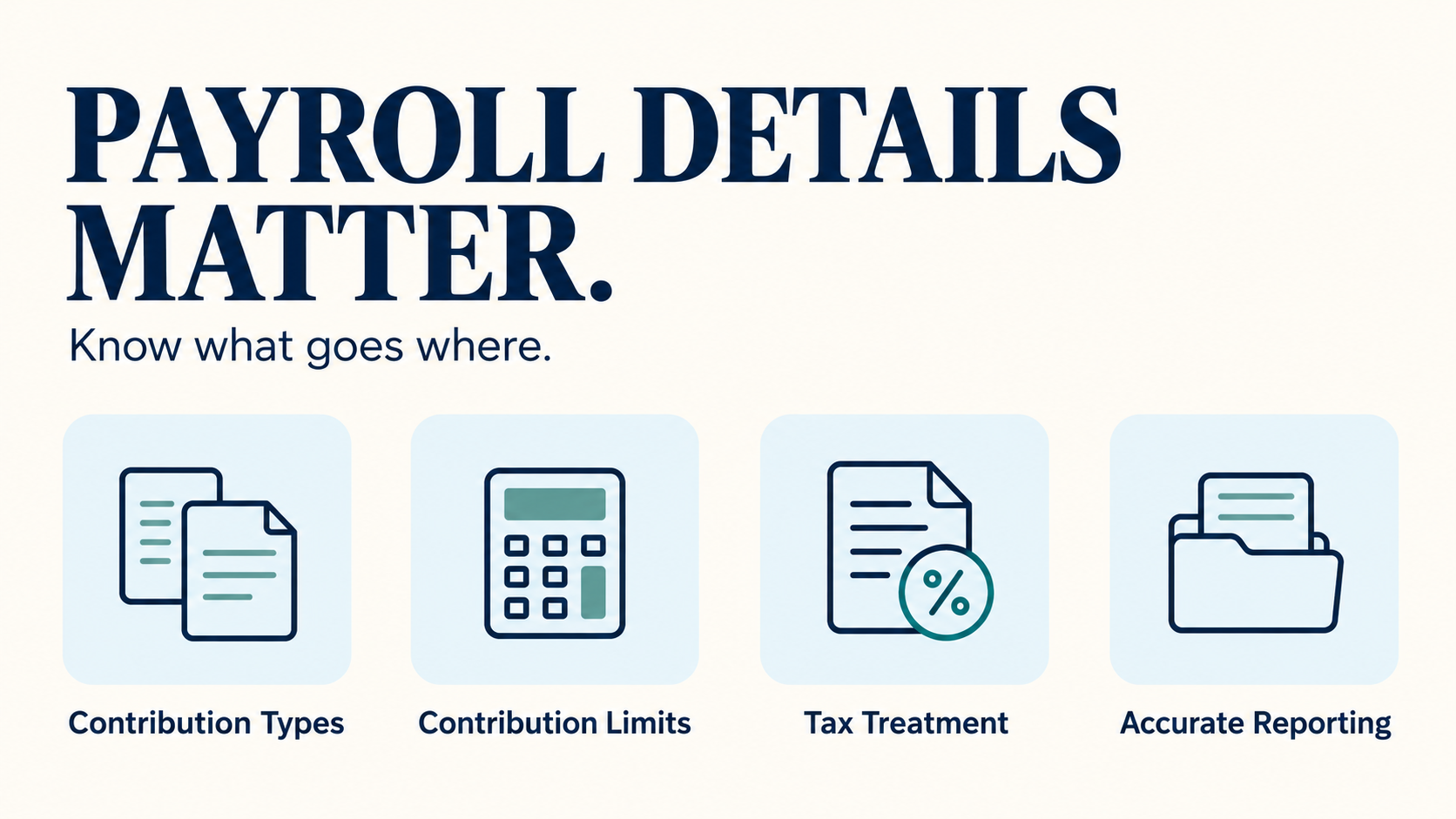
Before implementation, ask your payroll provider to explain how it will distinguish contribution types, apply limits, handle tax treatment, and produce accurate reporting.
For employers already balancing payroll, benefits administration, and employee requests, ASO/HRO support may help address the broader administrative workload. Confirm any TACP-specific capabilities and responsibilities separately rather than assuming an existing service agreement includes them.
Should Your Business Offer Trump Account Contributions?
Consider whether employees would value this benefit, how it fits alongside existing benefits, and what your company can administer consistently. Ask employees about their priorities without promising a program before its feasibility has been reviewed.
For an illustrative budget, contributing $1,000 for 40 participating employees would require $40,000 in contributions alone. Payroll taxes, administration, adviser fees, and communication costs would need separate consideration.
Now return to that leadership meeting. The strongest proposal is no longer simply, “Let’s offer this benefit.”
It is, “Here is the purpose, the budget, the proposed structure, and the person responsible for every part of implementation.”
That approach also belongs in a broader HR roadmap for a growing business. A new benefit should strengthen your people strategy without creating an unmanaged process.
Build the HR Support Behind the Benefit
HR Partners offers HR Consulting, ASO/HRO, and PEO services to support employers with HR strategy, payroll, benefits administration, and compliance processes.
The right starting point is a conversation about your existing HR structure, administrative capacity, and goals. Any TACP implementation should then be coordinated with your benefits, payroll, tax, legal, and account-service providers.
You do not need to make every HR decision alone. You need clear responsibilities and the right support around the decision.
Stop doing HR alone. Talk with HR Partners about your HR and payroll needs.
This article provides general information, not legal, tax, or investment advice. Confirm current requirements and provider capabilities before implementing a program.
Sources & Resources
IRS: Proposed regulations on employer contributions to Trump Accounts, August 11, 2026.
IRS Notice 2025-68, published in Internal Revenue Bulletin 2025-52: Initial guidance, including employer contribution limits and cafeteria-plan treatment.
IRS: Instructions for Form 4547: Account eligibility, contributions, and pilot-program elections.
Federal Register: Employer Contributions to Trump Accounts, REG-101355-26: Proposed operational requirements and payroll-tax treatment.
IRS: 2026 General Instructions for Forms W-2 and W-3: Box 12, Code TA reporting.
IRS: Initial Trump Account guidance: Account structure, withdrawal restrictions, and federal pilot contributions.