

As your business grows, so do the responsibilities tied to human resources—from payroll and compliance to employee benefits and risk management. If you’re looking to offload the burden and focus on scaling your operations, you’ve likely come across two major HR outsourcing options: the Professional Employer Organization (PEO) model and the Administrative Services Organization/Human Resources Outsourcing (ASO/HRO) model.

But how do you know which one is right for your business?
In this guide, we’ll break down the key differences, compare the benefits of each model, and help you determine which solution best supports your growth and compliance goals.
What Is a PEO?
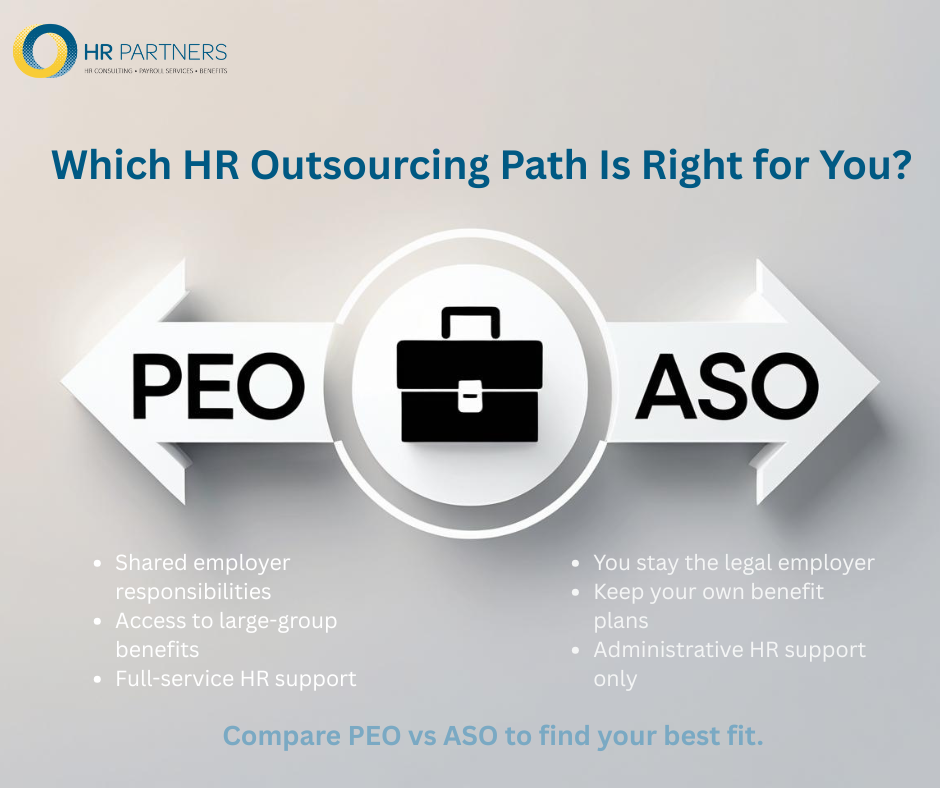
A Professional Employer Organization (PEO) is a co-employment model. A PEO is a third-party company that partners with businesses to handle various human resources (HR) tasks, including payroll, benefits administration, and compliance. Essentially, a PEO becomes a co-employer of a company’s workforce, handling administrative HR functions while the client company retains control over its core business operations.

What a PEO typically handles:
- Payroll processing and tax filing
- Employee benefits administration
- Workers’ compensation coverage
- HR compliance and regulatory support
- Onboarding, handbooks, and HR guidance
PEOs are particularly attractive to small and mid-sized businesses because they can offer access to enterprise-level benefits at group rates. According to the National Association of Professional Employer Organizations (NAPEO), businesses that use a PEO grow 7–9% faster, have 10–14% lower employee turnover, and are 50% less likely to go out of business (source).
What Is an ASO/ HRO?
ASO is also known as HRO (Human Resource Outsourcing). An Administrative Services Organization (ASO), also known as HRO, provides HR support without a co-employment relationship. You remain the legal employer and maintain all employment responsibilities, while the ASO supports your internal HR with tools and services.
 What an ASO typically offers:
- Payroll and tax filing under your business’s FEIN
- Benefits administration support (on your existing plans)
- HR consulting and documentation assistance
- Compliance updates and alerts
- Employee handbook creation and training materials
ASOs give you flexibility and control while still helping you save time and avoid costly mistakes. They’re ideal for companies that want administrative support but aren’t ready to enter a co-employment relationship.
PEO vs ASO: Side-by-Side Comparison
.png)
Which Model Is Best for You?
Choose a PEO if you:
- Want to offer competitive benefits without sourcing your own plans
- Need strong support with legal compliance and HR regulations
- Prefer a shared liability model for risk management
- Operate in multiple states or plan to scale quickly
Choose an ASO/HRO if you:
- Have at least 20+ employees
- Have internal HR staff but want to streamline administrative tasks
- Want to retain full legal and tax responsibility
- Don’t require pooled benefits or co-employment
- Prefer choosing your benefit providers and policies
Real-World Scenarios
Scenario A: A 25-employee tech startup expanding to three states chooses a PEO to simplify compliance, access high-quality benefits, and offload risk during rapid growth.
Scenario B: A 75-person manufacturing company with an internal HR team uses an ASO to handle payroll, maintain compliance documentation, assist with benefits administration, and assist with employee handbooks.
Legal and Compliance Considerations
Compliance missteps can be costly. According to the U.S. Department of Labor, employers paid over $230 million in back wages for wage violations in FY2023 alone (source). Both PEOs and ASOs help reduce these risks, but PEOs provide more proactive protection through shared responsibility and legal support.
If your company is navigating complex state laws, PEOs are particularly helpful. They can ensure multi-state compliance while managing everything from I-9 forms to anti-harassment policies.
For a compliance-focused guide, read our article on building a strong company culture through HR best practices.
Align with Your Business Goals
Both models serve valuable functions, but the right choice depends on your company’s size, growth stage, in-house resources, and risk tolerance.
- PEOs offer a full-service, all-in-one HR solution with access to premium benefits and legal protection.
- ASO/HRO models provide flexible administrative support for companies that want to retain more control and already have a handle on some HR functions.
At HR Partners, we offer both PEO and ASO/HRO options—and we guide our clients through selecting the best model to match their long-term strategy.
Get Expert Guidance on Your HR Outsourcing Model
Choosing the right HR solution can significantly impact your bottom line and long-term success. Let’s discuss your goals and explore which model best suits your business.
Schedule a free consultation with one of our HR experts today.