


Growing your business is an exciting milestone—but as your team expands, so do your HR responsibilities.
What works for a company with 10 employees rarely works for one with 100. Hiring accelerates, compliance requirements become more complex, payroll grows more demanding, and employee expectations evolve. Without a scalable HR strategy, these challenges can slow growth, increase risk, and divert leadership from focusing on the business.
Whether you’re building your first management team or leading a rapidly growing organization, having a clear HR roadmap helps ensure your people strategy grows alongside your business. For more than 28 years, HR Partners has partnered with organizations across a wide range of industries to simplify HR, strengthen compliance, and support their workforce. Through tailored HR solutions designed to meet each organization’s unique needs, HR Partners helps business leaders reduce administrative burdens, manage risk, and stay focused on growth.
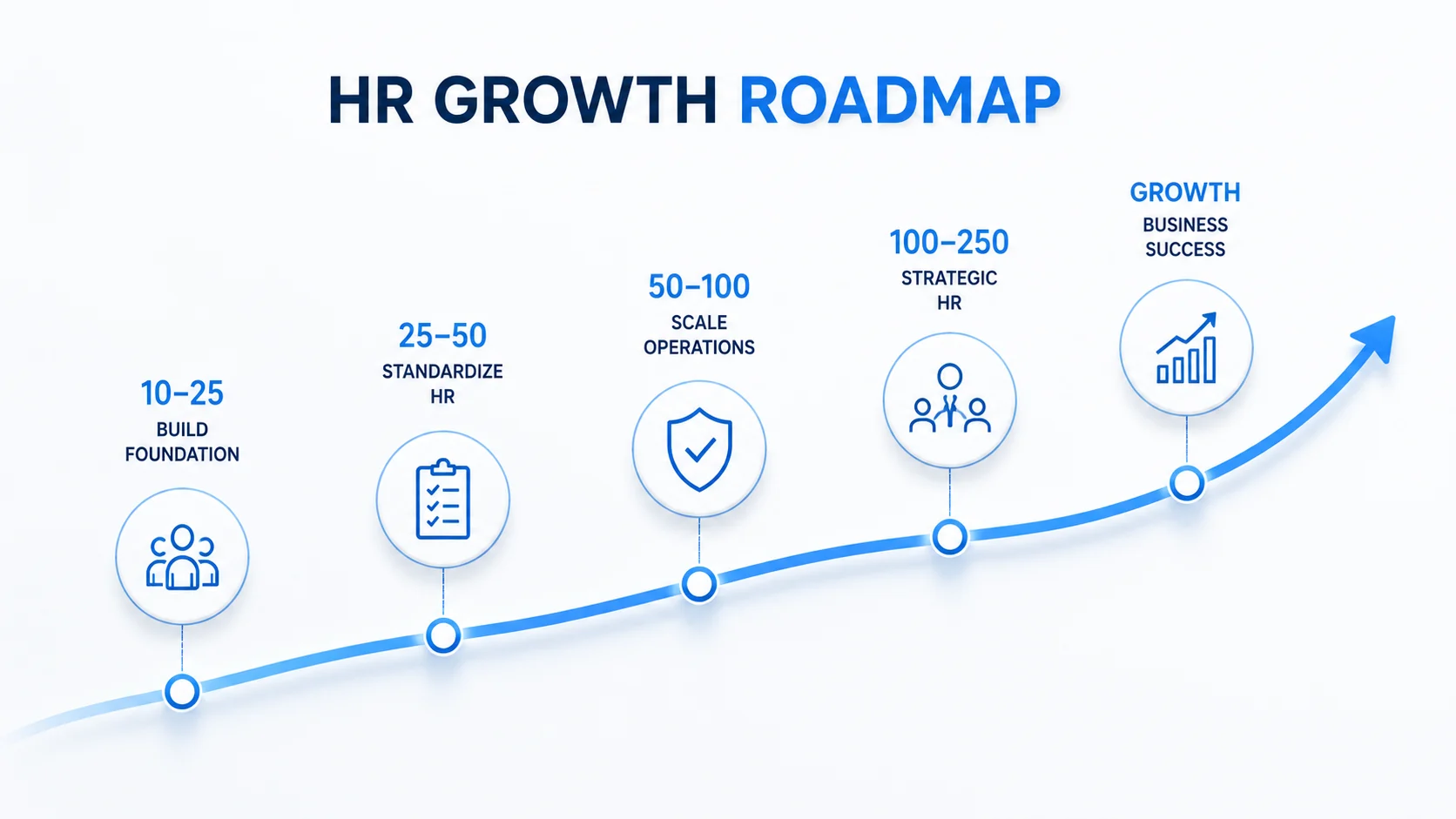
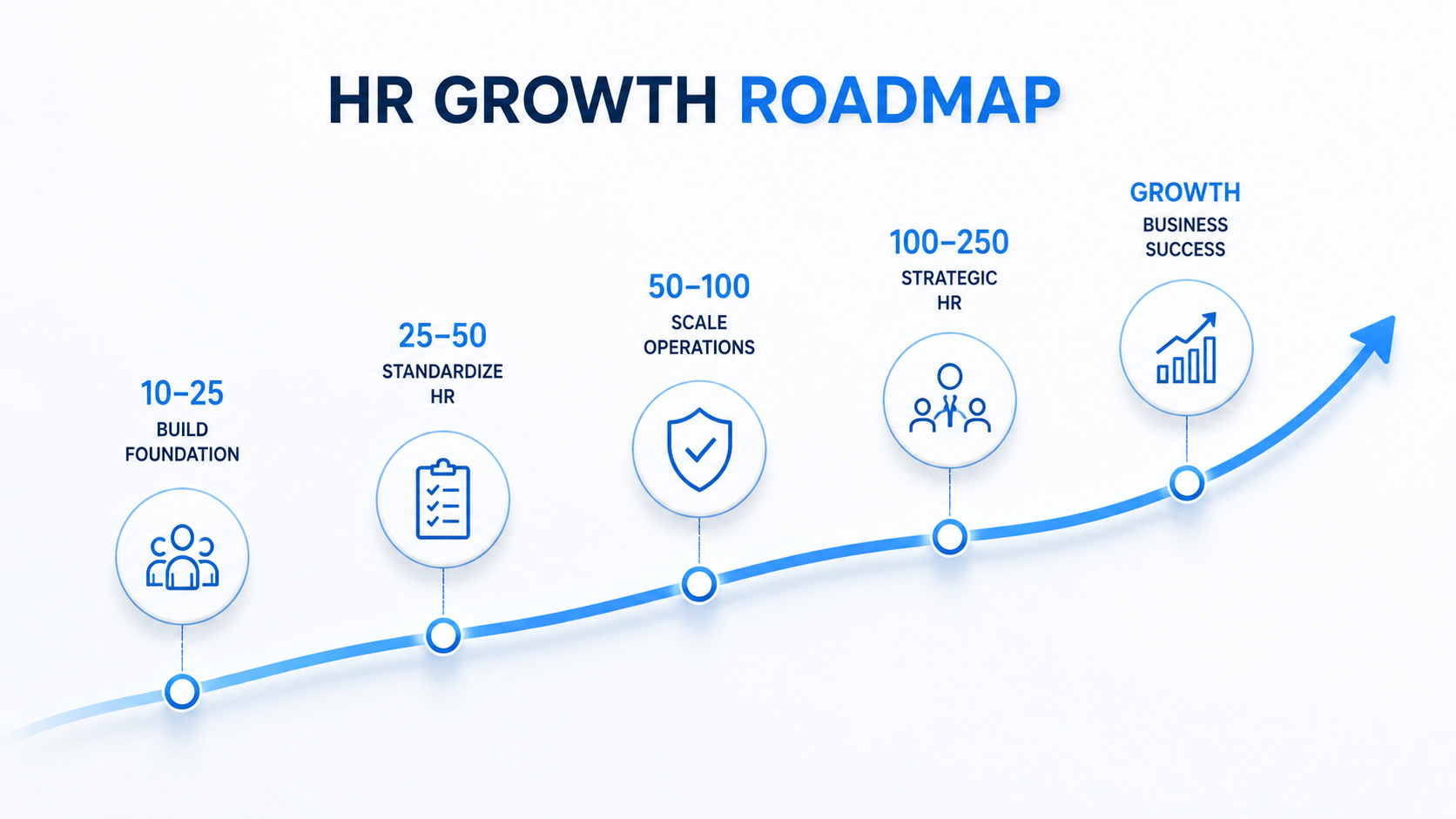
This roadmap outlines the key HR priorities for businesses with 10 to 250 employees and explains how to prepare for each stage of growth.
Why HR Becomes More Complex as Your Business Grows
Every new employee adds more than just another position—they introduce new responsibilities related to compliance, payroll, benefits, performance management, and workplace policies.
As organizations grow, HR impacts nearly every aspect of the business, including:
- Recruiting and hiring
- Payroll administration
- Employee onboarding
- Benefits management
- Employment law compliance
- Performance management
- Employee engagement
- Leadership development
- Workforce planning
Without structured HR processes, businesses often experience inconsistent hiring, compliance risks, operational inefficiencies, and higher employee turnover. Developing an HR roadmap early helps businesses remain organized, compliant, and prepared for sustainable growth.
Stage 1: 10–25 Employees — Build a Strong HR Foundation
At this stage, most businesses do not have a dedicated HR department.
HR responsibilities are often handled by the CEO, office manager, controller, or operations leader. While this may work initially, relying on informal processes can quickly create problems as hiring increases.
HR Priorities
- Develop an employee handbook
- Create clear job descriptions
- Establish payroll processes
- Standardize hiring procedures
- Implement structured onboarding
- Track employee time and attendance
- Maintain employee records
- Ensure compliance with employment regulations
Common Challenges
- Inconsistent hiring practices
- Payroll errors
- Missing employee documentation
- Lack of formal workplace policies
- Limited understanding of HR compliance requirements
Building these foundational processes early helps reduce future administrative burdens and minimizes compliance risks.
Stage 2: 25–50 Employees — Standardize HR Processes
As your workforce grows, HR responsibilities become more structured.
Managers begin leading larger teams, departments emerge, and employees expect consistent policies across the organization.
Without standardized HR processes, different managers may handle similar situations differently, creating confusion and increasing legal risk.
HR Priorities
- Standardize onboarding programs
- Introduce employee performance reviews
- Formalize PTO and leave policies
- Improve benefits administration
- Create recruiting workflows
- Train managers on employee relations
- Organize HR documentation
- Evaluate HR technology solutions
Many organizations at this stage begin exploring outsourced HR support to gain expertise without immediately expanding internal HR headcount.
Stage 3: 50–100 Employees — Strengthen Compliance and Scalability
Once a company reaches approximately 50 employees, HR becomes significantly more strategic.
Regulatory requirements become increasingly complex, and administrative tasks consume more executive time.
Organizations often experience:
- Faster hiring demands
- Increased employee relations issues
- More complex payroll administration
- Expanded benefits programs
- Greater compliance obligations
- Multi-state employment considerations
HR Priorities
- Conduct HR compliance audits
- Implement HRIS and payroll technology
- Improve employee benefits administration
- Develop performance management programs
- Invest in leadership development
- Strengthen employee engagement initiatives
- Reduce workplace risk
- Improve workforce reporting
At this stage, many growing businesses choose to partner with a Professional Employer Organization (PEO) to access comprehensive HR expertise, payroll administration, compliance guidance, and competitive employee benefits while maintaining operational control of their workforce.
Stage 4: 100–250 Employees — Make HR a Strategic Advantage
For companies approaching 250 employees, HR becomes a key driver of business performance.
Leadership teams begin focusing on long-term workforce planning rather than simply managing daily HR operations.
Strategic HR priorities include:
- Employee retention
- Leadership succession planning
- Organizational development
- Workforce analytics
- Employee experience
- Culture initiatives
- Talent development
- Strategic workforce planning
Organizations that invest in strategic HR often improve employee retention, strengthen leadership pipelines, and support long-term business growth. At this stage, HR plays a critical role in supporting business strategy. Companies often look for experienced HR partners who can provide strategic guidance, strengthen compliance, optimize people processes, and help leadership navigate continued growth with confidence
When Should You Outsource HR?
One of the biggest misconceptions about HR outsourcing is that it’s only for small businesses. In reality, organizations of all sizes can benefit from partnering with HR experts as their workforce grows and operations become more complex. If your leadership team is spending too much time on administrative HR tasks instead of focusing on business growth, it may be time to consider outsourcing. Increasing compliance requirements, more complicated payroll processes, rapid hiring, expanding employee benefits, or the need for specialized HR expertise are all signs that your organization could benefit from additional support. Outsourcing HR allows businesses to access enterprise-level resources, proven processes, and experienced professionals without the cost of building a larger internal HR department. The right solution ultimately depends on your company’s size, growth objectives, and operational needs.

Choosing the Right HR Solution
Every organization has unique HR challenges, which is why there is no one-size-fits-all approach to HR outsourcing. HR Partners offers flexible solutions that adapt to your business as it grows, whether you need comprehensive HR management, administrative support, or strategic guidance. Understanding the differences between these services can help you determine which option best aligns with your organization’s goals.
Professional Employer Organization (PEO)
A Professional Employer Organization (PEO) is designed for businesses looking for a comprehensive HR solution through a co-employment relationship. With a PEO, companies gain access to services such as payroll administration, employee benefits, HR compliance, workers’ compensation support, risk management, onboarding, and integrated HR technology. This solution allows business leaders to reduce administrative burdens while maintaining day-to-day control over their operations and employees. For growing organizations that want to strengthen compliance and offer competitive employee benefits, a PEO can provide the resources typically available only to much larger companies.
Administrative Services Organization (ASO/HRO)
Organizations that already have an internal HR team but need additional administrative support may find an ASO or HRO solution to be the best fit. Unlike a PEO, an ASO/HRO allows businesses to retain full control of their workforce while adding support for key HR functions such as payroll processing, benefits administration, HRIS management, compliance support, employee documentation, and other administrative tasks. This flexible approach enables companies to streamline operations, reduce manual workloads, and leverage HR expertise while maintaining full control over their workforce.
HR Consulting
Some businesses don’t need to outsource their HR department entirely—they simply need experienced guidance to address specific challenges or support strategic initiatives. HR Consulting services provide expert assistance with compliance audits, employee handbook development, workplace policies, leadership coaching, organizational restructuring, workplace investigations, employee relations, and long-term HR strategy. Whether your organization is navigating rapid growth, regulatory changes, or organizational transformation, HR consulting offers specialized expertise that helps leaders make informed decisions and build stronger workplaces.
HR Technology Is Essential for Growth
As businesses expand, manual HR processes become increasingly difficult to manage. Modern HR technology helps organizations automate repetitive tasks, improve accuracy, and create a better employee experience across the entire workforce. From payroll automation and time tracking to applicant tracking, digital onboarding, HR reporting, document management, and benefits administration, the right technology can significantly improve efficiency while reducing administrative errors. HR Partners combines experienced HR professionals with integrated HR technology solutions to help businesses simplify HR operations, improve compliance, and create scalable processes that support long-term growth.
HR Roadmap by Company Size
| Company Size | Primary HR Focus |
|---|---|
| 10–25 Employees | Employee handbook, onboarding, payroll, compliance fundamentals |
| 25–50 Employees | Standardized processes, performance management, benefits administration |
| 50–100 Employees | HR compliance, payroll automation, HR technology, employee engagement |
| 100–250 Employees | Strategic HR, leadership development, workforce planning, retention |
Why Growing Businesses Choose HR Partners
As organizations grow, HR becomes increasingly complex—but it doesn’t have to become overwhelming.
For more than 28 years, HR Partners has helped businesses navigate HR challenges through customized solutions that support growth, compliance, and their people. Whether you need a fully outsourced HR department, additional administrative support, or strategic HR guidance, HR Partners works alongside your leadership team to build scalable HR solutions that support long-term success.
With experience serving organizations across multiple industries, HR Partners helps businesses:
- Reduce administrative burdens
- Strengthen HR compliance
- Improve payroll and benefits administration
- Support employee growth and engagement
- Build scalable HR processes
- Focus leadership on business growth

Ready to Build a Stronger HR Strategy?
As your organization grows, your HR strategy should grow with it. Whether you’re hiring your 10th employee or managing a workforce of 250, having the right HR systems and expertise can improve operational efficiency, reduce compliance risk, and create a stronger employee experience. If you’re evaluating PEO, ASO/HRO, or HR Consulting services, the HR Partners team is ready to help you identify the best solution for your business. Contact HR Partners today to schedule a consultation and build an HR strategy designed for sustainable growth.
Frequently Asked Questions
What HR processes should a company have by 50 employees?
By 50 employees, organizations should have standardized hiring, onboarding, payroll administration, employee handbooks, performance management, benefits administration, HR technology, and documented compliance procedures.
When should a business outsource HR?
Businesses should consider outsourcing HR when compliance becomes more complex, hiring accelerates, payroll administration consumes excessive time, or internal HR resources are limited.
What is the difference between a PEO and an ASO?
A Professional Employer Organization (PEO) provides comprehensive HR services through a co-employment relationship, while an Administrative Services Organization (ASO/HRO) delivers HR administrative support without establishing a co-employment relationship.
How many employees should a company have before hiring HR?
Many businesses begin formalizing HR processes between 10 and 25 employees. Depending on growth goals and available resources, organizations may hire an HR professional or partner with an outsourced HR provider.
Sources
- U.S. Small Business Administration. Hire and Manage Employees. https://www.sba.gov/business-guide/manage-your-business/hire-manage-employees
- U.S. Department of Labor. Employment Laws and Regulations. https://www.dol.gov/
- Society for Human Resource Management (SHRM). HR Topics and Tools. https://www.shrm.org/