
5 Signs Manual HR Is Slowing Growth
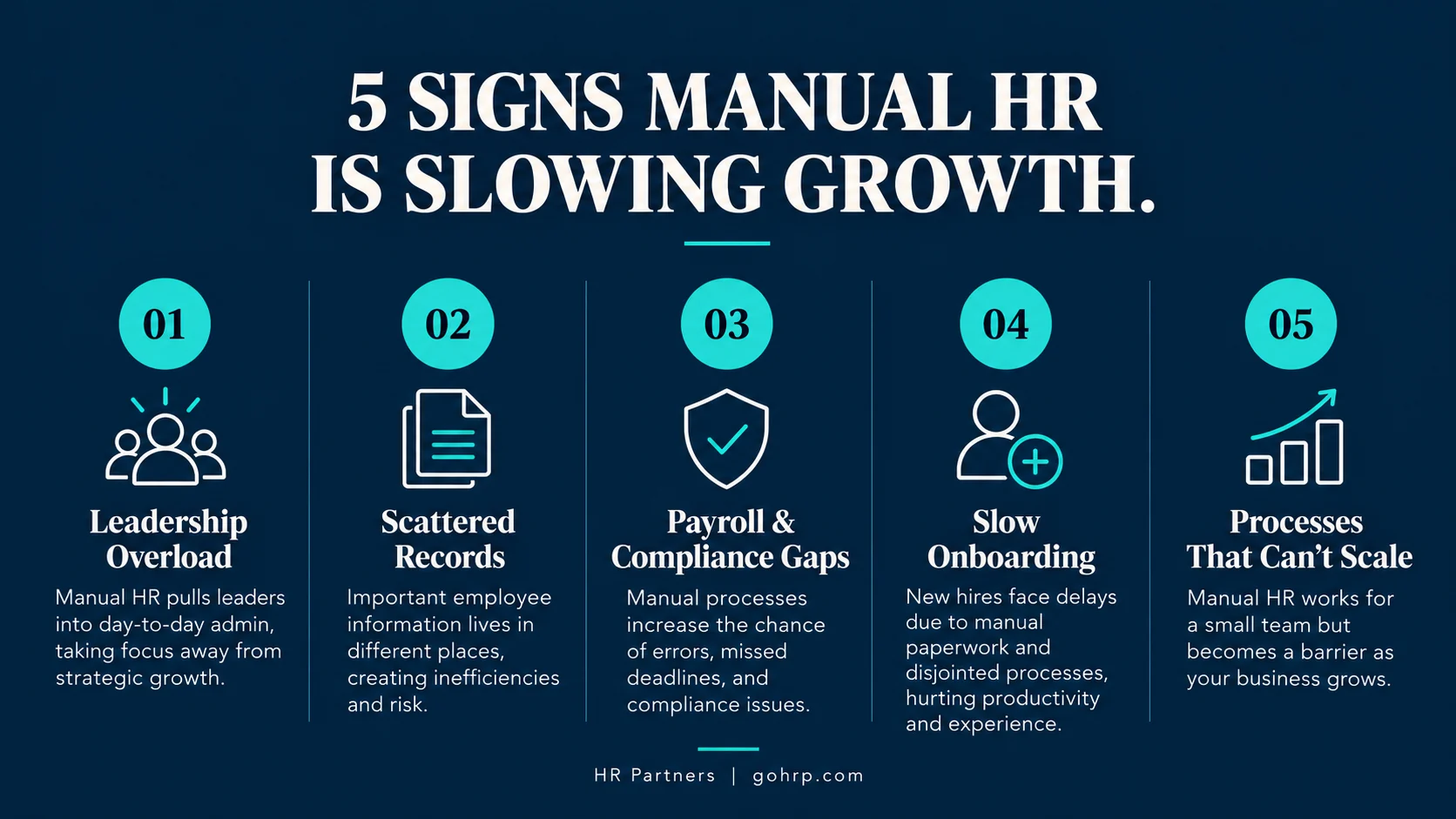
Your business is growing. Is your HR process keeping up?
A new client signs. Your team is hiring. Revenue is moving in the right direction.
But behind the scenes, your office manager is tracking employee information across spreadsheets. Payroll questions are landing in the CEO's inbox. Onboarding depends on whoever remembers the next step.
At first, these workarounds seem manageable. Everyone pitches in, and the business keeps moving.
Then growth makes every small administrative gap harder to ignore.
This is a common challenge in a growing company's HR: the business expands faster than the processes supporting its people.
The problem is not necessarily a lack of effort. It is that manual HR processes often become harder to coordinate, maintain, and scale as the workforce grows.
Here are five signs your business may have reached that point, and how HR management services can help.
1. Your Leadership Team Is Spending Too Much Time on HR Administration

Picture a CEO starting Monday with a clear list of priorities: review sales forecasts, meet with a potential customer, and prepare for expansion.
By noon, that same CEO has handled a payroll question, reviewed employee documents, and answered a manager's request about time off.
The strategic priorities are still waiting.
When business owners and senior leaders become the unofficial HR department, routine administration starts competing with growth.
Warning signs include:
- Executives regularly approving routine HR paperwork.
- Managers asking leadership to interpret basic policies.
- Payroll and employee questions repeatedly interrupting business decisions.
HR management services can help establish clearer processes and ongoing administrative support, giving leaders more time to focus on customers, employees, and business priorities.
2. Employee Information Is Spread Across Spreadsheets, Emails, and Folders
A spreadsheet may work when a company has a handful of employees.
But imagine a growing company with multiple managers, new hires, different work schedules, and employees working across locations.
One manager updates a spreadsheet. Another saves an older version. An employee emails a document that never reaches the right folder.
Nobody intends to create confusion, but the information is no longer consistently organized.
Manual employee administration can make it harder to track onboarding, employment changes, time-off requests, and important records.
The warning sign: Your team spends more time finding, verifying, and updating employee information than using it.
Centralized HR workflows, appropriate HR technology, and defined ownership can help reduce duplicate administrative work.
For companies that want to keep their internal HR team while strengthening administrative support, ASO/HRO services may provide a flexible approach.
3. Payroll and Compliance Depend on Someone Remembering Every Detail

Payroll does not become less important when a business gets busy.
Neither do wage-and-hour rules, employee records, or workplace policies.
The U.S. Department of Labor requires employers covered by applicable Fair Labor Standards Act provisions to maintain accurate records for covered, nonexempt employees. The Equal Employment Opportunity Commission also establishes employment recordkeeping requirements for covered employers.
As a business grows, managing these responsibilities through disconnected processes can create more opportunities for omissions and inconsistent documentation.
Consider a company opening a second location.
Suddenly, managers are coordinating different schedules, employee information, approvals, and possibly additional state or local employment requirements.
A process that worked for one location may need substantial updates.
Warning signs include:
- Payroll approvals depend on one person's availability.
- Employee records are difficult to locate.
- Policies have not been reviewed after business changes.
- HR responsibilities are unclear between managers and administrators.
Effective HR function management requires more than completing tasks. It requires documented procedures, assigned responsibilities, reliable records, and appropriate compliance guidance.
Explore HR Partners' HR compliance resources for additional considerations.
4. Hiring Is Increasing, but Onboarding Is Getting Slower
Hiring more employees should help your business increase its capacity.
But what happens when every new employee creates another round of emails, forms, reminders, and follow-ups?
Imagine three new hires starting on the same Monday.
One receives everything needed for the first day. Another is waiting for system access. The third arrives without a clear training schedule.
The company successfully recruited the employees, but its onboarding process was not ready to support them consistently.
The warning sign: Each new hire requires more manual coordination than your team can comfortably manage.
A repeatable onboarding process can establish clear responsibilities for documentation, payroll setup, orientation, training coordination, and employee communication.
For growing businesses, consistency matters because a smoother onboarding experience helps employees and managers start with clearer expectations.
5. Your HR Processes Cannot Keep Up With Your Growth Plans
The clearest sign that manual HR is slowing growth may appear before a major problem occurs.
Perhaps your business is preparing to open another location, hire 20 employees, or expand into a new state.
Your leadership team knows what it wants to achieve.
But nobody is entirely sure whether the current HR processes can support it.
That uncertainty matters.
Growth introduces new coordination demands, including employee administration, payroll processes, benefits administration, reporting, policy consistency, and workforce planning.
If every increase in headcount creates more manual work, your HR infrastructure may not be scaling with the business.
Ask yourself: Can our current HR process support twice as many employees without twice as much administrative effort?
If the answer is no, it may be time to evaluate a different approach.
How HR Management Services Help Growing Businesses
HR management services help businesses organize, administer, and support essential human resources functions.
Depending on the service model and agreement, support may include payroll administration, employee documentation, onboarding processes, benefits administration, HR technology, and compliance guidance.
The goal is not necessarily to replace your internal HR team.
It is to give your organization the support and processes it needs as responsibilities grow.
Two common human resources outsourcing models include:
ASO/HRO services: Administrative Services Organization and Human Resource Outsourcing solutions provide support for selected HR functions while the client generally remains the employer. This can work well for businesses seeking flexibility or support alongside an existing HR team.
PEO services: A Professional Employer Organization operates through a co-employment arrangement, taking on specified employer responsibilities while the business maintains day-to-day control of its operations and employees.
Learn more about ASO/HRO services and PEO services to understand which model may fit your organization.
Why Growing Businesses Choose HR Partners
Some businesses need a complete HR support structure. Others have a capable internal team but need additional resources for payroll, administration, technology, or compliance.
They should not have to choose a one-size-fits-all approach.
At HR Partners, we believe in full-service support, not simply handing businesses more software to manage.
Our approach focuses on:
- No Call Trees: Personalized service and continuity, so you can work with people who understand your business.
- True Customization: Flexible services built around what your organization actually needs.
- Collaborative Support: A team that works alongside yours, participates in conversations, and helps address practical HR challenges.
With experience supporting businesses since 1998, HR Partners provides PEO, ASO/HRO, and HR solutions designed to reduce administrative burdens and support sustainable growth.
You do not have to manage every HR responsibility alone.
Quick HR Growth Readiness Check
Before your next hiring round or expansion, ask:
- Can we find important employee records quickly and securely?
- Are payroll and HR approvals clearly assigned?
- Are our onboarding steps consistent?
- Have our policies and procedures kept pace with business changes?
- Can our HR processes support more employees without overwhelming leadership?
If several answers are no, consider reviewing your current HR responsibilities, technology, and support structure.
For a more complete framework, explore The Complete HR Roadmap for Companies With 10–250 Employees.
Frequently Asked Questions
Why do growing companies struggle to manage HR functions?
Growing companies often struggle because hiring, payroll, onboarding, recordkeeping, and compliance responsibilities expand faster than their internal processes. Manual workflows and unclear responsibilities can increase administrative delays. HR management services can help organizations establish more consistent processes and access additional support.
What are HR management services?
HR management services support business functions such as payroll administration, onboarding, employee records, benefits administration, HR technology, and compliance-related processes. Services vary by provider and agreement.
When should a small business outsource HR?
A small business may benefit from human resources outsourcing when administrative work regularly interrupts leadership, employee information becomes difficult to manage, payroll processes depend heavily on one person, or growth creates additional HR complexity.
Can a business outsource HR without replacing its internal HR team?
Yes. ASO/HRO services can complement an existing HR team by supporting selected administrative or specialized functions while internal HR continues managing employee relationships, culture, and workforce strategy.
Stop Letting Manual HR Set the Pace of Your Growth
Your business should not have to slow down because its HR processes have become too complicated.
Whether you are managing 15 employees or preparing for your next stage of expansion, the right HR support can help you build a stronger administrative foundation.
HR Partners works with growing businesses to simplify HR responsibilities, strengthen processes, and give leadership more room to focus on what comes next.
Stop doing HR alone.